Fit Guide · September 2026 · 9 min read
The Lingerie Fabric and Fit Glossary: Every Term, Plainly Explained
Band, gore, bonded edge, power mesh, sister sizing — the vocabulary of lingerie is rarely explained to the people buying it. Here is the whole glossary, in plain language, from the VELRA atelier.
Short Answer
- The band of a bra carries roughly eighty per cent of the support, and the straps carry only the remaining twenty per cent.
- A band that rides up at the back is too loose rather than too tight, and the correct fix is a smaller band size.
- Sister sizing means going down a band size and up a cup letter, such as 36C to 34D, keeps cup volume roughly the same with a firmer band.
- The gore is the fabric bridge between the cups at centre front, and it should lie flat against the sternum in a correctly fitting bra.
- A bonded edge is fused with heat and pressure instead of sewn, so there is no thread ridge to print through fine fabric.
- Power mesh is a firm open-knit fabric used in bra wings to give smoothing and light compression while staying breathable.
- Modal is a cellulose fibre made from beech pulp that is softer and more colour-stable than cotton and does not pill in the same way.
- Recovery describes how well a fabric returns to its original shape after stretching, and poor recovery is why bras loosen over time.
- Heat and fabric softener are the two main causes of premature elastane failure in lingerie.
Lingerie is described in a language almost nobody is taught. You are asked to know your band, your gore, your sister size, whether you want power mesh or double-knit modal — and then judged, quietly, for choosing badly. We think that is backwards. What follows is the vocabulary we use in the atelier every day, written out plainly, so you can read any product page anywhere and know exactly what is being promised.
Fit Terms: The Anatomy of a Bra
Almost every fit problem traces back to one of these seven parts. Learning their names is the fastest way to describe what is wrong to someone who can fix it.
- Band — the horizontal strip that circles your ribcage. It carries roughly eighty per cent of the support; straps carry the rest. A band that rides up your back is too loose, not too tight.
- Cup — the shaped section holding each breast. Cup volume is relative to band size, which is why the same letter means different things on different bands.
- Gore — the small bridge of fabric between the two cups at the centre front. On a well-fitting bra it lies flat against the sternum; if it floats away, the cup is too small.
- Underband / underbust — the measurement taken snugly directly beneath the bust, which determines band size.
- Apex — the fullest point of the cup, which should sit at the fullest point of the breast. A low apex reads as a droopy silhouette even in the correct size.
- Wing — the side panel connecting cup to back closure. A tall wing gives smoothing and side support; a short wing is lighter but less containing.
- Cradle — the frame beneath and around the cups that anchors their shape. On wireless designs this is done with bonded structure rather than metal.
Sister Sizing, and Why It Works
Cup volume is proportional, not absolute. Go down one band size and up one cup letter — 36C to 34D — and the cup holds nearly the same volume with a firmer band. Go the other way, 36C to 38B, and you keep the volume with a looser band. These are sister sizes, and they are the single most useful trick in lingerie. If a bra is right in the cup but loose in the band, you do not need a different style; you need the sister size down.
Fabric Terms: What You Are Actually Wearing
- Microfibre — an ultra-fine synthetic filament, typically polyamide, spun thinner than silk. It is what gives a second-skin bra its weightless, matte hand-feel.
- Modal — a cellulose fibre made from beech pulp. Softer and more colour-stable than cotton, and it does not pill the way cotton knits do after repeated washing.
- Double-knit — two layers of knit fabric constructed as one. It gives opacity and gentle structure without adding a lining, padding or foam.
- Elastane (Lycra, spandex) — the stretch fibre. Content usually runs eight to twenty per cent; more elastane means more stretch but also faster fatigue with heat.
- Power mesh — a firm, open-structure knit used in wings and side panels for smoothing and light compression. Breathable, and far lighter than it looks.
- Bonded edge — a hem fused with heat and pressure rather than sewn, so there is no thread and no ridge to print through fine fabric.
- Moulded cup — a cup shaped with heat into a fixed form, rather than assembled from seamed panels. Smooth on the outside, consistent in shape.
- Recovery — the fabric's ability to return to its original dimensions after stretching. Poor recovery is why a bra loosens after a month.
- GSM — grams per square metre, the weight of the fabric. Lower GSM is lighter and more invisible; higher GSM is more supportive and opaque.
Construction Terms
- Seamless — knitted or constructed with no joining seams across the cup surface, so nothing shows under fitted clothing.
- Wireless (soft cup) — support built from fabric engineering, band tension and cradle structure rather than a metal underwire.
- Racerback — straps converging between the shoulder blades. It pulls the straps inward, which stops slipping on sloping shoulders.
- Hook-and-eye — the traditional back closure. Multiple rows exist so the band can be tightened as elastane relaxes with age.
- Pullover / clasp-free — a band with no closure at all, stepped into or pulled over the head. Flatter under clothing, and nothing to feel when you lie back.
- Scoop back — a lowered, rounded back line that stays hidden beneath open-back and wide-neck clothing.
How to Use This When You Are Actually Shopping
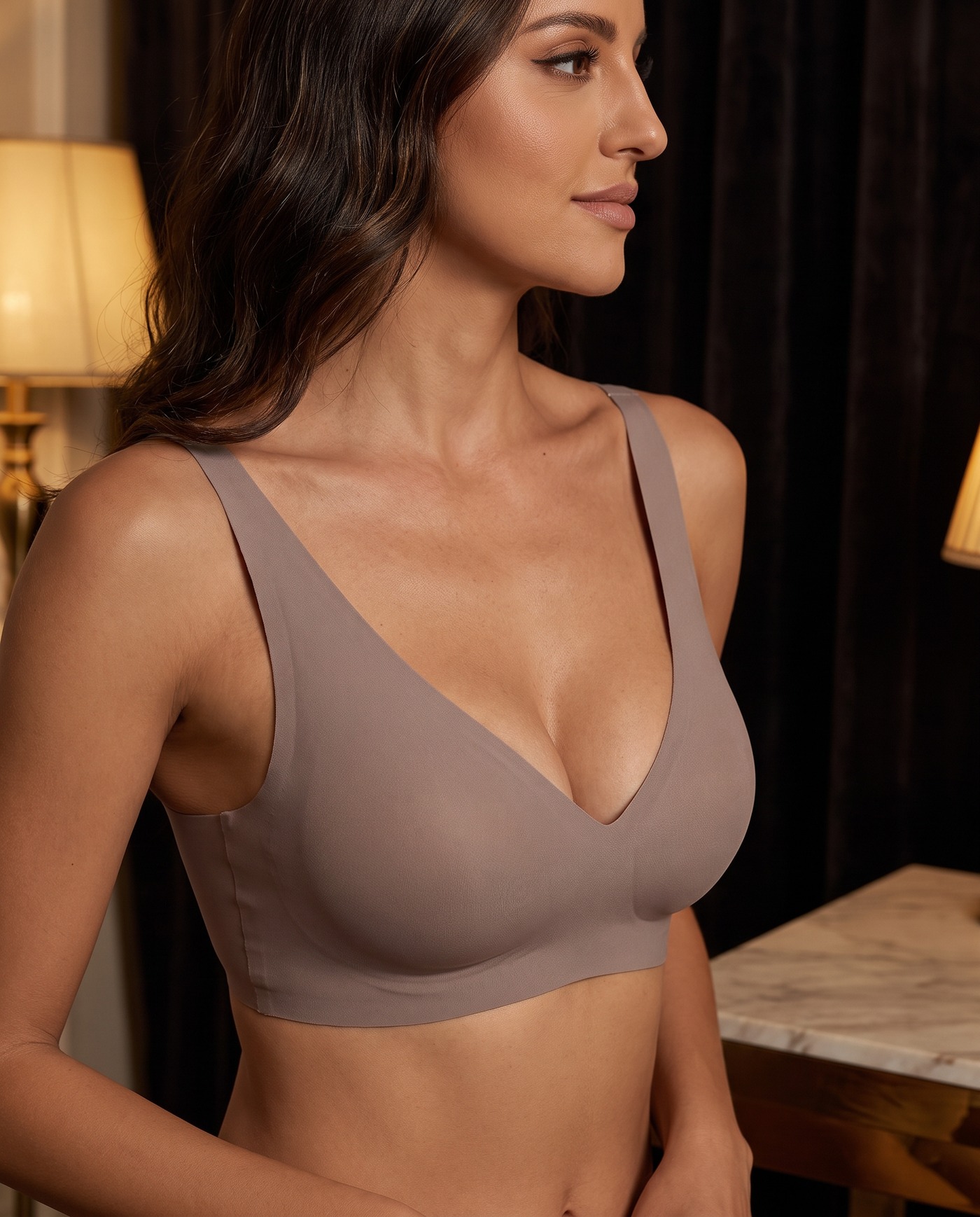
Read a product page in this order: band closure first, because it decides comfort; then fabric weight and elastane content, because they decide how long it lasts; then cup construction, because it decides shape. A page that names none of these is not telling you much. Our Lumen Bonded Seamless Bra is a bonded, clasp-free, double-knit build — a useful reference point for reading the vocabulary against a real garment.
The Care Vocabulary
Two words do most of the damage. Heat destroys elastane and softens bonded edges, which is why tumble drying shortens a bra's life faster than anything else. Fabric softener coats the elastane filament and kills recovery, so a bra that fitted perfectly stops holding after a few washes. Cool water, no softener, dry flat and away from direct sun — that is the entire care routine, in every fabric named above.
Questions, answered
What is the band on a bra, and why does it matter most?
The band is the horizontal strip that circles your ribcage beneath the bust. It carries around eighty per cent of a bra's support, with the straps carrying the rest. This is why band fit is the first thing to check: if the band rides up at the back, it is too loose and the straps are being asked to do work they cannot do.
What does sister sizing mean?
Sister sizes are pairs of sizes that hold nearly the same cup volume with a different band. Going down a band and up a cup — 36C to 34D — keeps the volume and firms the band; going up a band and down a cup — 36C to 38B — keeps the volume and loosens the band. It is the standard fix when the cup is right but the band is not.
What is the gore of a bra?
The gore is the small bridge of fabric between the two cups at the centre front. On a correctly fitting bra it sits flat against the sternum. If it floats away from the body, the cup is usually too small and volume is pulling the gore forward.
What is the difference between modal and cotton in lingerie?
Modal is a cellulose fibre made from beech pulp. It is spun finer than cotton, which makes it softer against the skin, more colour-stable through washing, and far less prone to pilling. Cotton is breathable but heavier, slower to dry and loses its surface smoothness with repeated wear.
What is power mesh used for?
Power mesh is a firm knit with an open structure, used in the wings and side panels of a bra to smooth and lightly compress without adding weight or bulk. Its open construction keeps it breathable despite being noticeably firmer than the main body fabric.
What is a bonded edge?
A bonded edge is a hem fused together with heat and pressure rather than joined with thread. Because no stitching is added and no fabric is doubled over, the edge stays completely flat, so it does not print through silk, fine knits or a fitted dress.
Why do bras lose their fit over time?
Elastane fatigue. The stretch fibre in the band and cups gradually loses recovery, so the band no longer holds tension. Heat from tumble drying and residue from fabric softener both accelerate this dramatically, which is why cool hand washing and flat drying make the biggest difference to how long a bra fits properly.
What does wireless support actually mean?
It means the support comes from fabric engineering rather than a metal underwire: a firm band, a structured cradle beneath the cups, and a knit calibrated so the cup holds shape under load. Done well, it supports comparably to underwire for most body types, with no rigid frame against the ribcage.